Citations are a key currency in research. They show how ideas spread, help measure the influence of papers and researchers, and feed into journal rankings such as impact factors. Because citations matter so much, some individuals and journals have tried to game the system. One of the most organised forms of this manipulation is the citation cartel.
This article on citation cartels explained covers what they are, how they work, why they form, how they are detected, their consequences, and what researchers and institutions can do to prevent citation manipulation.
Table of Contents
What Is a Citation Cartel?
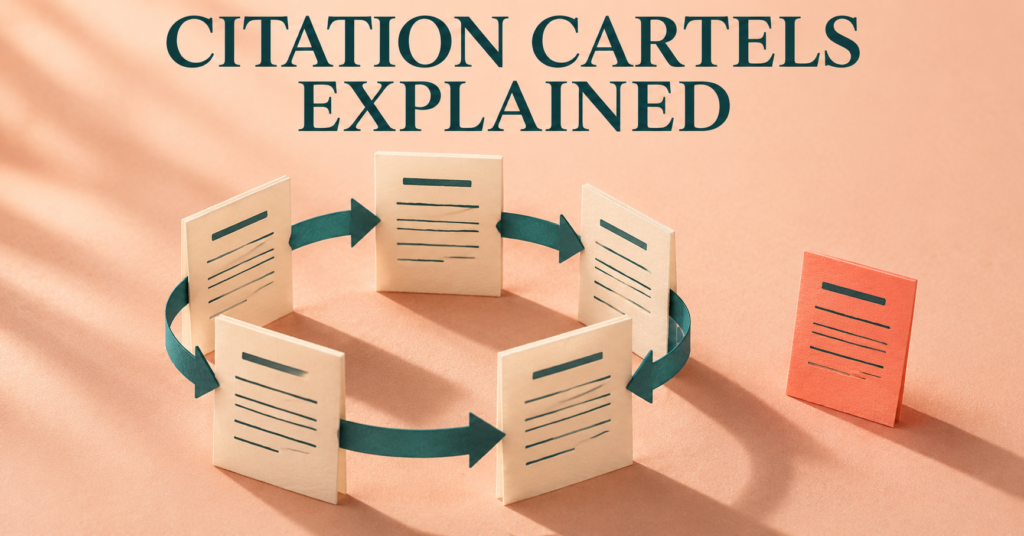
A citation cartel is a group of researchers, editors, or journals that agree, formally or informally, to cite each other’s work excessively in order to boost citation counts and metrics. The citations are often unrelated or only loosely related to the topic, added mainly for strategic benefit rather than scholarly relevance.
Types of Citation Manipulation
| Type | How It Works |
|---|---|
| Citation cartels or rings | Groups of researchers repeatedly cite each other |
| Citation stacking | Journals publish articles heavily citing another journal to raise its metrics |
| Coercive citation | Editors or reviewers pressure authors to cite their journal or work |
| Excessive self-citation | Authors or journals cite themselves far beyond relevance |
| Citation selling | Paying for citations, sometimes through paper mills |
How Citation Cartels Work
Between Researchers
A group of authors agrees to cite one another’s papers, even when the work is not closely related. Over time, each member’s citation counts and h-index rise, making them appear more influential.
Between Journals
Editors of different journals may coordinate to publish articles that cite each other’s journals heavily, increasing impact factors. Review articles packed with citations to a partner journal are one common method.
Through Peer Review
Reviewers may request that authors add citations to the reviewer’s own papers, sometimes making acceptance seem dependent on it. Editors may similarly push authors to cite recent articles from the same journal.
Through Paper Mills
Some paper mills include irrelevant citations in fake papers, effectively selling citations to clients who want to boost their metrics.
Why Citation Cartels Form
- Metric-based evaluation: hiring, promotion, and funding decisions often consider citation counts
- Journal rankings: impact factors influence a journal’s reputation and submissions
- University rankings: citation performance contributes to some global rankings
- Financial incentives: bonuses or prestige linked to metrics
- Competition: pressure to stand out in crowded fields
The underlying problem is that metrics designed to measure influence can be manipulated once they become targets.
How Citation Cartels Are Detected
Citation manipulation can often be identified through data analysis:
- Unusual citation patterns: a small group of authors or journals citing each other much more than expected
- Sudden metric spikes: large, unexplained increases in citations
- High self-citation rates: compared with similar journals or researchers
- Irrelevant references: citations unrelated to the paper’s topic
- Clusters of review articles: citing specific journals unusually often
- Reviewer reports: evidence of repeated citation requests
Statistical network analysis can reveal tightly connected citation groups that stand out from normal patterns.
Action by Indexing Services
Citation databases monitor for manipulation. Clarivate, which publishes the Journal Citation Reports, has suppressed journals from receiving impact factors when it found evidence of excessive self-citation or citation stacking, and has excluded journals implicated in citation cartels.
Consequences of Citation Cartels
For Science
- Distorted measures of influence and importance
- Misleading signals about which research is valuable
- Irrelevant references cluttering papers
For Journals
- Suppression from impact factor listings
- Removal from indexes
- Reputational damage
For Researchers
- Investigations and possible misconduct findings
- Loss of trust from peers and institutions
- Corrections or retractions of affected papers
- Damage to careers if metrics are found to be artificially inflated
Legitimate vs Manipulative Citation
Not all frequent citation is suspicious. Researchers naturally cite colleagues working on similar problems, and self-citation is often appropriate when building on earlier work. The key questions are whether citations are relevant, proportionate, and chosen for scholarly reasons rather than strategic advantage.
Why Metrics Are So Vulnerable
The economist Charles Goodhart’s widely quoted idea is often summarised as: when a measure becomes a target, it ceases to be a good measure. Citation counts were originally designed to help track how research is used, not to serve as the main basis for hiring or funding decisions. Once careers and rankings depend heavily on them, the incentive to manipulate grows.
A Simple Illustration
Imagine five researchers in different countries who agree to add several citations to each other’s papers in every article they publish, regardless of relevance. Within a few years, each person’s citation count and h-index rise sharply. To a hiring committee looking only at numbers, they appear highly influential. But a closer look at the citations would reveal that many have little connection to the topics being discussed. This is why responsible evaluation looks at content, not just counts.
Coercive Citation in Peer Review
Coercive citation can be difficult for authors to resist, especially early-career researchers who worry about rejection. Requests may be phrased as helpful suggestions, but repeated insistence on citing the reviewer’s or journal’s own work, without clear relevance, is widely considered unethical. Publication ethics guidance encourages editors to remove such requests and authors to report them.
What Researchers Can Do
- Cite only sources that are relevant to your work
- Avoid adding citations simply because a reviewer or editor requests them without justification
- Report coercive citation requests to the journal editor or publisher
- Be cautious of invitations to join citation-sharing arrangements
- Use metrics responsibly when evaluating others
What Journals and Institutions Can Do
- Set clear policies against coercive citation
- Monitor reviewer requests for self-citations
- Investigate unusual citation patterns
- Use a range of indicators, not just citations, in evaluations
- Support research assessment reforms that value quality
Signs You May Be Asked to Join a Citation Scheme
- Offers to “exchange” citations with other researchers
- Requests from editors to cite a list of the journal’s recent papers
- Reviewers insisting on adding many of their own papers
- Invitations to write reviews that must cite specific journals
Politely declining and reporting such requests helps protect the integrity of the literature and your own reputation.
Moving Beyond Citation Counts
Many institutions are now adopting broader ways of evaluating research. Initiatives that promote responsible metrics encourage evaluators to read and assess the actual work, consider a range of contributions such as data sharing and mentoring, and avoid relying on journal impact factors or citation totals alone. These reforms make citation manipulation less rewarding and help focus attention on genuine quality.
Final Thoughts
With citation cartels explained, it is clear how pressure on metrics can lead to manipulation. By citing each other strategically, cartels inflate citation counts and journal impact factors, distorting the true influence of research. Detection tools, indexing sanctions, and reforms that reduce reliance on metrics are helping to address the problem, but honest citation practices by every researcher remain the best defence.