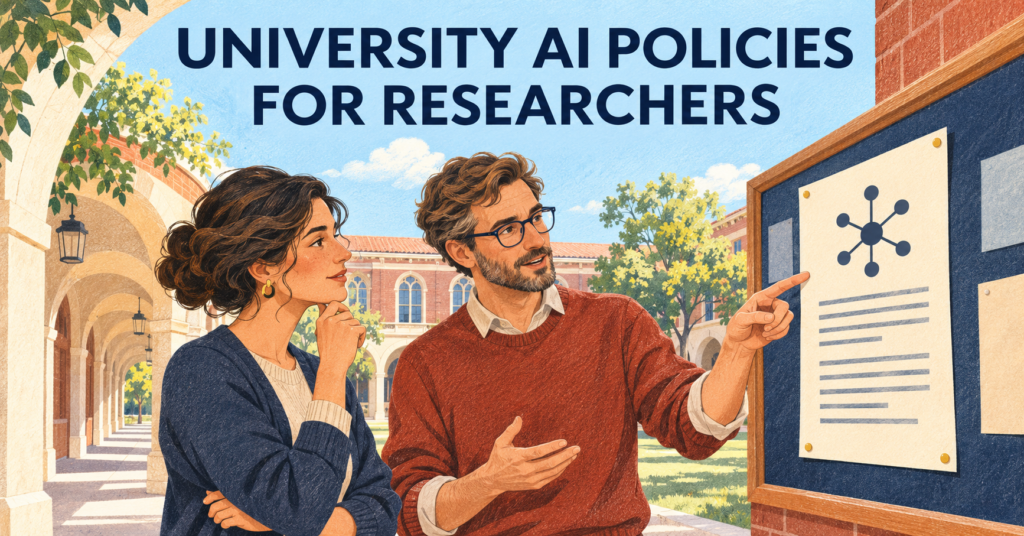
Generative AI has rapidly entered university life. Researchers use AI tools to draft text, analyse data, write code, summarise papers, and prepare grant applications. In response, universities around the world have developed policies to guide responsible use. Understanding these policies is now an essential part of doing research.
This guide to university AI policies for researchers explains what these policies usually cover, common rules and principles, how they apply to theses, publications, grants, and data, and how researchers can stay compliant as rules continue to evolve.
Table of Contents
Why Universities Have AI Policies
- Protecting research integrity: preventing fabrication, plagiarism, and misrepresentation
- Ensuring accountability: making clear that humans remain responsible for their work
- Protecting data: safeguarding confidential, personal, and sensitive information
- Supporting innovation: encouraging responsible and beneficial use of AI
- Meeting external requirements: aligning with journal, funder, and legal rules
What University AI Policies Typically Cover
| Area | Common Expectations |
|---|---|
| Transparency | Disclose substantive AI use in research outputs |
| Accountability | Researchers are responsible for all AI-assisted content |
| Data protection | Do not enter confidential or personal data into unapproved tools |
| Authorship | AI tools cannot be authors |
| Theses and degrees | Follow specific rules for doctoral and master’s work |
| Approved tools | Use institution-licensed or approved AI services where required |
Common Principles in AI Policies
Human Responsibility
Almost every policy states that researchers remain fully responsible for the accuracy, originality, and integrity of their work, regardless of whether AI tools were used.
Transparency and Disclosure
Researchers are generally expected to disclose meaningful AI use in publications, theses, and reports, describing the tool and its purpose.
Verification
Because AI can produce errors and fabricated references, policies often require researchers to check every fact, citation, and output.
Fairness and Bias Awareness
Some policies encourage researchers to consider whether AI tools may introduce bias, especially in research involving people or decision-making.
AI in Theses and Dissertations
Doctoral and master’s theses are assessed as evidence of a candidate’s own abilities, so universities often have stricter rules. Common requirements include:
- Declaring any use of generative AI tools
- Agreeing AI use with supervisors in advance
- Not using AI to write substantial parts of the thesis unless explicitly permitted
- Being able to explain and defend all content during examination
- Keeping records of AI use, sometimes including prompts
Students should check graduate school regulations and departmental guidance carefully.
AI in Publications
Universities usually require researchers to follow journal and publisher policies. Key points often include:
- AI cannot be listed as an author
- Substantial AI use should be disclosed as required by the journal
- AI-generated images of research data are generally not acceptable
- All references and data must be verified
AI in Grant Applications
Funders are developing their own rules. Some allow limited AI assistance with writing, provided applicants take full responsibility, while others warn about risks such as plagiarism or confidentiality. Many funders prohibit reviewers from using AI to assess applications. University research offices often help researchers understand these requirements.
Data Protection and Confidentiality
One of the most important parts of AI policy concerns data. Researchers are typically advised not to enter the following into public AI tools:
- Personal or identifiable participant data
- Health records or sensitive information
- Unpublished research findings
- Confidential manuscripts or grant applications under review
- Commercially sensitive or contract-restricted data
Doing so may breach ethics approvals, privacy laws, or contracts. Many universities provide approved AI tools with stronger data protections for research use.
AI in Research Methods
When AI is part of the research itself, such as machine learning analysis, automated transcription, or AI-assisted coding of qualitative data, policies typically expect:
- Clear description of tools, versions, and settings in methods sections
- Validation of AI outputs
- Ethics committee approval where AI processes participant data
- Consideration of bias and reproducibility
How Policies Differ Between Universities
Although the core principles are similar, universities take different approaches:
- Permissive with disclosure: AI use is generally allowed if disclosed and verified
- Case-by-case: departments or supervisors decide what is appropriate for each project
- Restrictive for assessment: stricter rules for theses and examinations than for published research
- Tool-specific: only approved, institution-licensed AI tools may be used for certain work
Researchers who move between institutions, or collaborate across countries, should not assume that the rules are the same everywhere.
Collaborative and International Projects
When research teams span several universities, each partner may have different AI rules. It is good practice to agree on AI use at the start of a project, follow the strictest relevant policy for shared data, and record decisions in project documentation. This avoids confusion when papers are written and submitted.
Where to Find Help
Most universities offer support through research integrity offices, graduate schools, libraries, IT services, and data protection officers. Libraries in particular often provide guidance on AI tools for literature searching and on citing AI use correctly.
Consequences of Breaching Policy
Misusing AI may lead to:
- Academic integrity investigations
- Research misconduct proceedings
- Retraction of publications
- Penalties affecting degrees, employment, or funding
Most institutions distinguish between honest mistakes and deliberate deception, but researchers are expected to follow rules and seek advice when uncertain.
Questions to Ask Your Supervisor or Research Office
- Which AI tools are approved for research data in our institution?
- What level of AI use is acceptable in my thesis or project?
- How should I record and disclose AI use?
- Does my ethics approval allow AI processing of participant data?
- What do our main funders and target journals require?
Asking these questions early helps avoid problems at the submission or examination stage.
Policies Are Living Documents
Most universities describe their AI guidance as evolving. As technology, laws, and publisher rules change, policies are reviewed and updated, sometimes several times a year. Researchers should check for new versions regularly, especially before starting a new project or submitting a thesis.
How Researchers Can Stay Compliant
- Read your university’s AI policy and any departmental guidance
- Check journal and funder rules for each project
- Use approved tools for sensitive or confidential work
- Keep a simple AI use log recording tools and purposes
- Disclose AI use clearly in outputs
- Verify all AI-assisted content
- Talk to supervisors, integrity offices, or data protection teams when unsure
- Stay updated, as policies are changing rapidly
Balancing Opportunity and Risk
AI policies are not designed only to restrict researchers. Many universities actively encourage staff and students to explore AI tools that can save time, improve accessibility, and support new kinds of research. The aim is to use these tools thoughtfully, with clear safeguards, rather than to avoid them altogether. Researchers who understand both the benefits and the risks are best placed to use AI effectively.
Final Thoughts
University AI policies for researchers aim to balance innovation with integrity. While details vary between institutions, the core message is consistent: use AI transparently, protect data, verify every output, and remember that responsibility always rests with the researcher. By understanding and following these policies, researchers can benefit from AI while maintaining trust in their work.