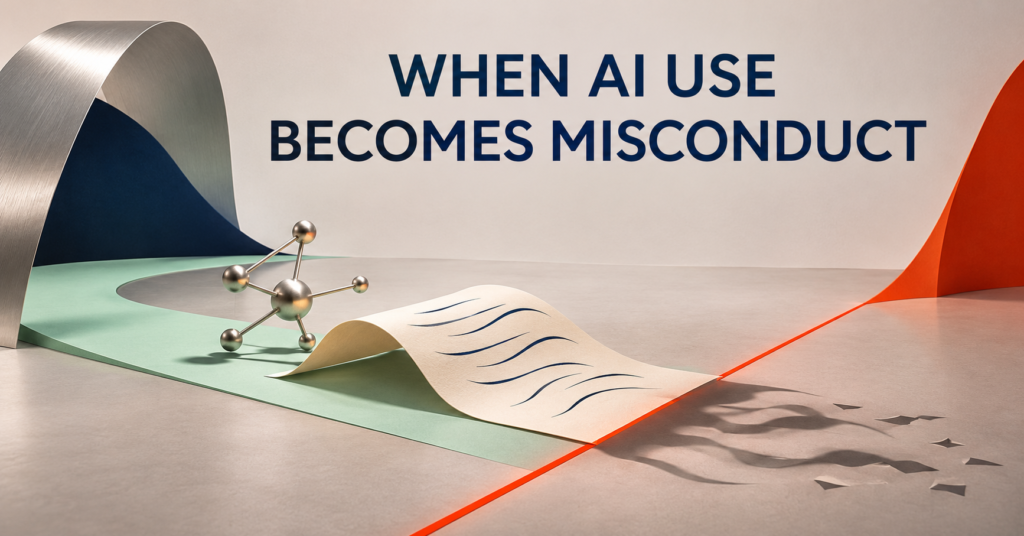
Generative AI tools can help researchers write more clearly, analyse data, and work more efficiently. Many universities and journals now allow AI use, as long as it is disclosed and carefully checked. But there is a line. When AI is used to deceive, fabricate, or misrepresent work, it can become research misconduct, with serious consequences for careers and the scientific record.
This article explains when AI use becomes misconduct, the difference between acceptable and unacceptable uses, common warning signs, real-world risks, how institutions respond, and how researchers can stay on the right side of the line.
Table of Contents
What Counts as Research Misconduct?
In many countries and institutions, research misconduct is defined mainly as:
- Fabrication: making up data or results
- Falsification: manipulating research materials, equipment, processes, data, or images
- Plagiarism: using others’ ideas, words, or work without proper credit
Many policies also cover related breaches, such as misrepresenting authorship, failing to disclose conflicts of interest, or breaching confidentiality. AI does not create new categories of misconduct, but it can make existing types easier to commit and harder to detect.
Acceptable vs Problematic AI Use
| Generally Acceptable (with disclosure where required) | Potential Misconduct |
|---|---|
| Improving grammar and readability | Generating fake data or results |
| Brainstorming ideas and search terms | Creating fabricated references and presenting them as real |
| Help with coding, checked by the researcher | Producing manipulated or fake images |
| Explaining complex concepts | Passing off AI-written work as entirely your own where rules forbid it |
| Drafting text that is verified and disclosed | Uploading confidential manuscripts during peer review against policy |
When AI Use Becomes Misconduct
1. Fabricating Data
Using AI to generate survey responses, patient records, experimental measurements, or interview transcripts and presenting them as real data is fabrication. This is one of the most serious forms of misconduct.
2. Falsifying or Manipulating Results
Using AI to alter data, smooth results, remove inconvenient values, or adjust images in ways that misrepresent findings is falsification.
3. Creating Fake Images
AI image generators can produce realistic microscopy images, gels, or photographs. Presenting AI-generated images as genuine experimental results is fabrication. Many journals now restrict or ban AI-generated images in research papers.
4. Inventing References
AI tools can produce citations to papers that do not exist. Knowingly including fake references, or carelessly failing to check them, misrepresents the evidence base and may be treated as misconduct or serious negligence.
5. AI-Assisted Plagiarism
Using AI to paraphrase other people’s work to avoid plagiarism detection, without crediting the original sources, is still plagiarism. Changing words does not change who owns the ideas.
6. Undisclosed AI Authorship
Where journals, universities, or funders require disclosure, presenting substantially AI-generated text as entirely human-written may breach policies on transparency and authorship.
7. Breaching Confidentiality
Uploading unpublished manuscripts, grant applications, or sensitive participant data into public AI tools may violate confidentiality agreements, ethics approvals, or data protection rules.
8. Mass-Produced Papers
Using AI to generate large numbers of low-quality or fake papers, a practice associated with paper mills, is a serious integrity violation.
Intent and Negligence
Misconduct policies often consider whether actions were intentional, knowing, or reckless. Honest mistakes, such as a grammar tool introducing a small error, are generally not misconduct. However, ignoring clear rules, failing to verify AI outputs, or using AI to deliberately deceive can cross the line. Researchers are expected to take responsibility for everything they submit, regardless of which tools were used.
Warning Signs Editors and Reviewers Notice
- References that cannot be found or do not support the cited claims
- Generic, repetitive text lacking specific detail
- Data that look too perfect or follow unrealistic patterns
- Images with unusual textures or inconsistencies
- Leftover AI phrases, such as chatbot-style responses accidentally pasted into a paper
- Methods that do not match the reported results
How Institutions and Journals Respond
When AI-related concerns arise, responses may include:
- Requests for raw data, code, and original files
- Corrections or retractions of published papers
- Rejection of manuscripts or grant applications
- Institutional misconduct investigations
- Academic penalties for students, including failing grades or expulsion
- Employment or funding consequences for researchers
Many journals follow guidance from publication ethics bodies, which state that AI tools cannot be authors and that authors are fully responsible for AI-assisted content.
Grey Areas
Not every case is clear-cut. Questions institutions are still working through include:
- How much AI editing is acceptable before disclosure is required?
- Is AI-assisted analysis acceptable if the code is checked?
- How should AI-generated summaries in literature reviews be handled?
- What counts as “substantial” AI contribution?
When in doubt, the safest approach is to check policies, disclose openly, and ask supervisors or editors for advice.
Three Illustrative Scenarios
Scenario One: Language Polishing
A researcher writes a full manuscript and uses an AI tool to improve grammar and flow. They review every change and disclose the use as required by the journal. This is generally acceptable.
Scenario Two: Missing Data
A student loses part of a dataset and asks an AI tool to generate “realistic” values to fill the gap, without telling anyone. This is fabrication and a serious breach of integrity.
Scenario Three: Unchecked References
An author asks AI for supporting references and pastes them into the paper without checking. Several turn out not to exist. Even without intent to deceive, this careless practice can lead to rejection, retraction, or an integrity investigation.
Responsibilities of Supervisors and Institutions
Preventing AI-related misconduct is not only the responsibility of individual researchers. Supervisors can set clear expectations with students, discuss acceptable uses openly, and review data and drafts regularly. Institutions can provide training, publish clear policies, offer approved tools for sensitive work, and create safe channels for asking questions. A culture that encourages honesty and early disclosure reduces the temptation to cut corners.
How to Use AI Without Crossing the Line
- Know the rules: read journal, university, and funder AI policies
- Never fabricate: data, images, and results must come from genuine research
- Verify everything: check every citation, fact, and statistic
- Disclose use: describe how AI was used where required
- Protect confidentiality: avoid uploading sensitive or unpublished material to public tools
- Keep records: note which tools were used and for what purpose
- Take responsibility: remember that AI cannot be held accountable; you can
Reporting Concerns
If you suspect AI has been misused in research, raise the concern through appropriate channels, such as a research integrity office or journal editor. Provide specific evidence and allow fair processes to take place.
Staying Informed
AI technology and related policies change quickly. Researchers should review guidance from their institutions, funders, and journals regularly, especially when starting new projects.
Final Thoughts
Understanding when AI use becomes misconduct is essential for every researcher and student. AI can be a valuable assistant, but using it to fabricate data, create fake images, invent references, disguise plagiarism, or hide its role can cross into serious misconduct. By following policies, verifying outputs, disclosing use, and keeping human judgement at the centre, researchers can benefit from AI while protecting their integrity.