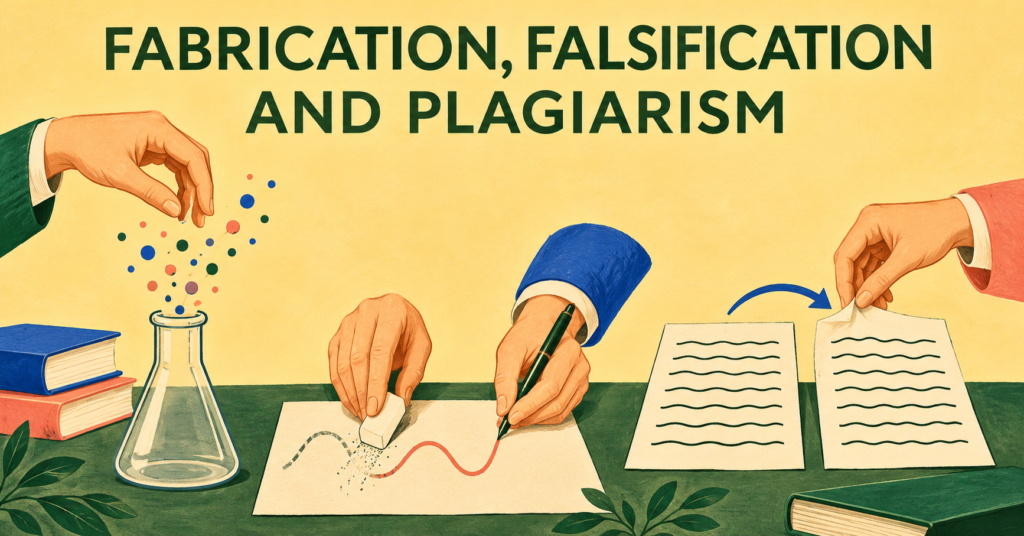
Research depends on honesty. When scientists report their findings, readers trust that the data are real, the methods were followed as described, and the words and ideas belong to the people credited. Three serious breaches of that trust are fabrication, falsification and plagiarism, often abbreviated as FFP. Together, they form the core definition of research misconduct in many countries and institutions.
This article explains fabrication, falsification and plagiarism in detail, with examples, how they differ from honest error and questionable practices, why they happen, how they are detected, their consequences, and how researchers can prevent them.
Table of Contents
What Is Research Misconduct?
Many research integrity policies define research misconduct as fabrication, falsification, or plagiarism in proposing, performing, reviewing, or reporting research. These policies usually specify that research misconduct does not include honest error or differences of opinion.
FFP at a Glance
| Type | Definition | Example |
|---|---|---|
| Fabrication | Making up data or results and recording or reporting them | Inventing survey responses that were never collected |
| Falsification | Manipulating materials, equipment, processes, data, or images so the record is inaccurate | Deleting inconvenient data points without justification |
| Plagiarism | Using another person’s ideas, processes, results, or words without credit | Copying paragraphs from another paper without citation |
Fabrication Explained
Fabrication means creating data or results that do not exist. It is often considered the most serious form of misconduct because it introduces entirely false information into the scientific record.
Examples of Fabrication
- Inventing participants or patient records in a clinical study
- Reporting experiments that were never performed
- Creating fake interview transcripts
- Generating artificial datasets and presenting them as real
- Producing AI-generated images and presenting them as experimental results
Falsification Explained
Falsification involves changing or misrepresenting real research so that the results are not accurately reflected. Unlike fabrication, the research may have actually taken place, but the reported record is distorted.
Examples of Falsification
- Altering numbers to make results statistically significant
- Removing data that do not fit the hypothesis without disclosure
- Manipulating images, such as splicing gel bands or duplicating microscopy fields
- Misrepresenting methods, sample sizes, or equipment used
- Selectively reporting outcomes in a misleading way
Plagiarism Explained
Plagiarism is presenting someone else’s work as your own. It can occur in research papers, grant applications, theses, peer reviews, and presentations.
Examples of Plagiarism
- Copying text without quotation marks or citation
- Paraphrasing someone’s ideas without acknowledgement
- Using another researcher’s data, images, or figures without permission or credit
- Taking ideas from a manuscript you reviewed confidentially
- Using AI paraphrasing tools to disguise copied text
What Is Not Research Misconduct?
Not every mistake or disagreement is misconduct. Policies typically exclude:
- Honest errors: genuine mistakes in calculation, coding, or recording
- Differences of opinion: disagreements about interpretation or methods
- Unintentional oversights: such as missing a citation by accident, though this may still need correction
To be considered misconduct, many policies require that the act was committed intentionally, knowingly, or recklessly.
Questionable Research Practices
Between honest research and FFP lies a grey zone of questionable research practices, which may not meet the formal definition of misconduct but still damage reliability. Examples include:
- P-hacking, or trying many analyses until significance appears
- Changing hypotheses after seeing results
- Selective reporting of positive findings
- Inadequate record keeping
- Gift or ghost authorship
These practices are increasingly addressed through training, pre-registration, and open science reforms.
Why FFP Happens
- Pressure to publish for jobs, promotions, or degrees
- Competition for funding
- Desire for recognition or high-impact publications
- Fear of failure or disappointing supervisors
- Poor supervision and weak research culture
- Lack of training in research integrity
- Belief that misconduct will not be detected
How FFP Is Detected
- Similarity-checking software: identifies copied text
- Image analysis: detects duplicated or altered figures
- Statistical checks: reveal impossible or unusually perfect data
- Raw data requests: journals or institutions ask for original records
- Whistleblowers: colleagues or students who notice problems
- Replication attempts: other researchers fail to reproduce results
- Integrity sleuths: independent experts examining published work
Consequences of FFP
- Retraction of publications
- Loss of employment or academic degrees
- Bans from receiving research funding
- Damage to reputation and careers
- Legal consequences in some cases, especially involving public funds or patient harm
- Harm to patients, the public, and other researchers relying on false findings
FFP Across the Research Process
Misconduct can occur at any stage, not only when papers are written.
- Grant proposals: plagiarising text or falsifying preliminary data
- Data collection: inventing participants or measurements
- Analysis: altering data or misreporting statistical results
- Publication: manipulating figures or copying text
- Peer review: stealing ideas from manuscripts under review
Integrity policies usually apply to all these activities, not just published papers.
How Investigations Work
When an allegation of FFP is made, institutions typically follow a structured process. An initial assessment determines whether the concern falls under misconduct policies. An inquiry then decides whether a full investigation is needed. During an investigation, a committee examines records, data, and interviews before reaching findings. Accused researchers have the right to respond, and people who report concerns in good faith should be protected from retaliation. Outcomes are often shared with journals and funders when publications or grants are affected.
The Wider Cost of Misconduct
The harm caused by FFP goes beyond individual careers. Other scientists may spend years trying to build on false results, patients may be exposed to ineffective or unsafe treatments, and public funding may be wasted. Each confirmed case also weakens public trust, making it harder for honest researchers to communicate their findings.
How to Prevent FFP
For Researchers
- Keep accurate, detailed records of data and methods
- Store original raw data and images securely
- Report all results honestly, including negative findings
- Cite sources carefully and use quotation marks where needed
- Seek advice when unsure about data handling or citation
For Institutions
- Provide research integrity training
- Encourage open data and transparency
- Offer safe channels for raising concerns
- Reform incentives that overemphasise publication counts
- Investigate allegations fairly and promptly
Common Myths About Research Misconduct
- “Only famous scientists commit fraud”: misconduct occurs at all career levels and in all fields
- “Small changes do not matter”: even minor falsification distorts the scientific record
- “Paraphrasing removes plagiarism”: ideas still require credit
- “It is impossible to detect”: detection tools and data checks are increasingly powerful
Building a Culture of Integrity
Preventing FFP is not only about rules and detection. Research groups with open communication, regular data review, fair authorship practices, and supportive supervision tend to have fewer integrity problems. When team members feel safe discussing mistakes and uncertainties, problems are more likely to be caught early.
Final Thoughts
Fabrication, falsification and plagiarism are the most serious forms of research misconduct because they directly corrupt the scientific record. Fabrication invents data, falsification distorts it, and plagiarism takes credit for others’ work. By understanding these breaches, distinguishing them from honest error, and building strong habits of record keeping, transparency, and proper citation, researchers and institutions can protect the integrity of science.