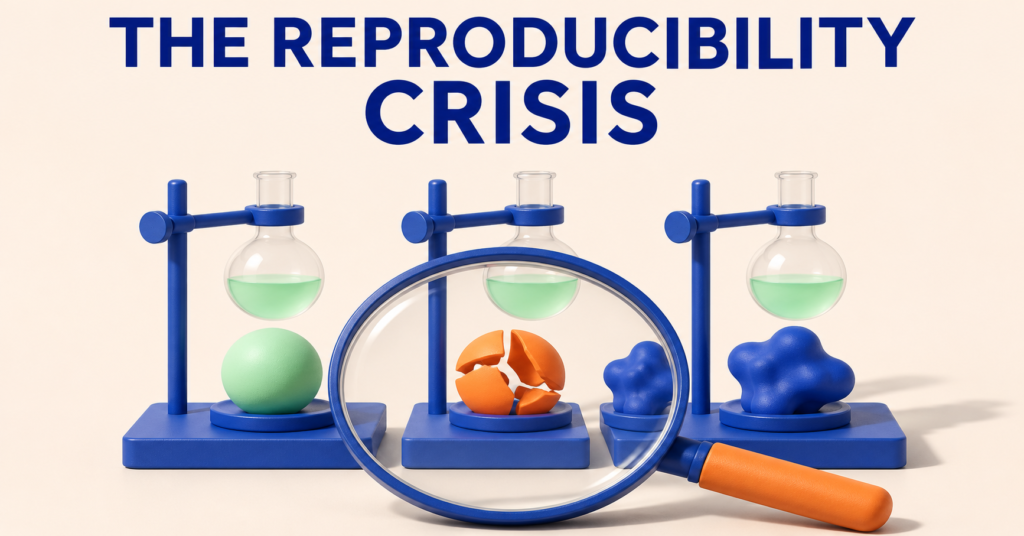
Science is built on the idea that results can be checked. If a finding is true, other researchers should be able to repeat the work and reach similar conclusions. Over the past two decades, however, many fields have discovered that a surprising number of published findings are difficult or impossible to reproduce. This problem has become known as the reproducibility crisis.
This article on the reproducibility crisis explains what it is, how it came to light, its main causes, which fields are affected, its consequences, and the reforms that are helping to make research more reliable.
Table of Contents
Reproducibility vs Replicability
The terms are sometimes used interchangeably, but many researchers distinguish between them:
- Reproducibility: obtaining the same results using the original data and analysis methods
- Replicability: obtaining consistent results in a new study that collects new data to answer the same question
Both are important. Failures of either can suggest problems with the original research, though they can also reflect natural variation or differences in conditions.
How the Crisis Came to Light
Concerns about reliability have existed for a long time, but several high-profile studies and reports brought the issue into the spotlight.
| Year | Development | Key Message |
|---|---|---|
| 2005 | John Ioannidis publishes “Why Most Published Research Findings Are False” | Statistical and design problems may make many findings unreliable |
| 2011 to 2012 | Pharmaceutical companies report difficulty reproducing published preclinical studies | Many promising lab findings did not hold up |
| 2015 | Large collaborative project attempts to replicate 100 psychology studies | Only a minority produced similarly significant results |
| 2016 | Nature survey of researchers | Most respondents had failed to reproduce another scientist’s experiment |
| 2021 | Cancer biology replication project reports results | Many replicated effects were much weaker than originally reported |
Psychology
In 2015, the Open Science Collaboration published results from an effort to replicate 100 studies from leading psychology journals. While nearly all of the original studies reported significant results, only around a third of the replications did. The project prompted widespread reflection and reform in the field.
Biomedical Research
Reports from pharmaceutical companies, including Amgen and Bayer, described how in-house scientists could reproduce only a fraction of published preclinical studies they tried to confirm. Later, a large project focused on cancer biology found that many replicated experiments showed much smaller effects than the original papers.
Main Causes of the Reproducibility Crisis
Small Sample Sizes
Studies with few participants or samples have low statistical power. They are more likely to miss real effects and to produce exaggerated or false positive results.
P-Hacking and Flexible Analysis
When researchers try many different analyses, they may eventually find a statistically significant result by chance. Without pre-planned analysis, it can be hard to tell which results are robust.
Publication Bias
Journals have historically favoured positive, novel, and exciting results. Studies finding no effect often remain unpublished, creating a distorted picture of the evidence.
Pressure to Publish
Career incentives that reward the number of publications and high-impact findings can encourage speed over careful confirmation.
Poor Reporting
Missing details about methods, materials, or analyses make it difficult for others to repeat studies accurately.
Lack of Data and Code Sharing
When data and code are not available, other researchers cannot check or reproduce the original analysis.
Variation in Materials and Conditions
In laboratory research, differences in cell lines, reagents, equipment, and environments can affect results. Contaminated or misidentified materials have also caused problems.
Misconduct
Although most irreproducible research results from honest mistakes or poor practices, a small proportion involves fabrication or falsification.
Which Fields Are Affected?
The reproducibility crisis is not limited to one discipline. Concerns have been raised in:
- Psychology and behavioural sciences
- Biomedical and preclinical research
- Economics
- Neuroscience and brain imaging
- Ecology and environmental sciences
- Computer science and artificial intelligence, where code and data availability are crucial
The degree of the problem varies between fields and depends on research methods, culture, and incentives. Fields with strong traditions of data sharing and large collaborations often face fewer issues.
Why It Matters
- Wasted resources: funding and time spent building on unreliable findings
- Delayed progress: promising drug leads or theories may fail later
- Health risks: unreliable research can influence medical decisions
- Policy concerns: decisions may be based on weak evidence
- Loss of trust: public confidence in science may decline
Reforms and Solutions
The crisis has sparked a wave of reform, often grouped under the open science movement.
- Pre-registration: recording hypotheses and analysis plans before data collection
- Registered reports: journals accepting studies based on their methods before results are known
- Open data and code: sharing materials so others can check and reproduce work
- Larger samples and collaboration: multi-lab studies with greater statistical power
- Better reporting guidelines: detailed checklists for methods and results
- Replication studies: greater recognition and funding for confirming previous findings
- Improved statistics training: helping researchers design and analyse studies correctly
- Research assessment reform: valuing quality and transparency over quantity
Signs of Progress
Since the crisis gained attention, research culture has started to change in visible ways:
- More journals now offer registered reports and require data availability statements
- Large collaborative networks run the same experiments across many laboratories
- Funders increasingly ask for data management plans and support replication studies
- Researchers use online platforms to share protocols, materials, and code
- Reporting guidelines for clinical trials, animal studies, and other designs are widely adopted
- Training in open science and statistics has become more common in graduate programmes
These changes take time to show their full effect, but together they are making it easier to check, repeat, and build on published research with greater confidence.
Understanding Statistical Power
Statistical power is the chance that a study will detect a real effect if one exists. A study with low power is like trying to hear a quiet conversation in a noisy room: you may miss what is said, or think you heard something that was not there. Increasing sample sizes, reducing measurement error, and carefully planning studies all improve power and make results more trustworthy.
Is Science Broken?
The reproducibility crisis does not mean science is broken. In fact, identifying and addressing these problems shows science’s ability to correct itself. Many well-established findings are robust and have been confirmed many times. The crisis highlights the importance of treating single studies with caution and placing greater trust in findings supported by multiple independent lines of evidence.
What Researchers and Readers Can Do
- Design studies with adequate sample sizes
- Plan and register analyses in advance where possible
- Share data, code, and materials
- Report all results, including null findings
- Be cautious about dramatic claims from single studies
- Look for replications and systematic reviews
Final Thoughts
The reproducibility crisis has challenged researchers to rethink how science is done, reported, and rewarded. From psychology to cancer biology, efforts to repeat published studies have revealed weaknesses but also inspired powerful reforms. Through pre-registration, open data, larger collaborations, and better incentives, the research community is building a more transparent and reliable foundation for future discoveries.