Peer review is meant to ensure that published research is accurate, well designed, and meaningful. But how should it be done? Should reviewers stay anonymous, or should everyone’s identity and comments be open for all to see? This question lies at the heart of one of the biggest debates in academic publishing: open vs blind peer review.
This article explains the main types of peer review, how open and blind models work, their advantages and disadvantages, what research suggests, and how authors and reviewers can choose the right approach.
Table of Contents
What Is Peer Review?
Peer review is the process in which experts evaluate a research manuscript before it is published. Reviewers assess the quality of the methods, analysis, and conclusions, and give recommendations to the journal editor. The editor then decides whether to accept, reject, or request revisions.
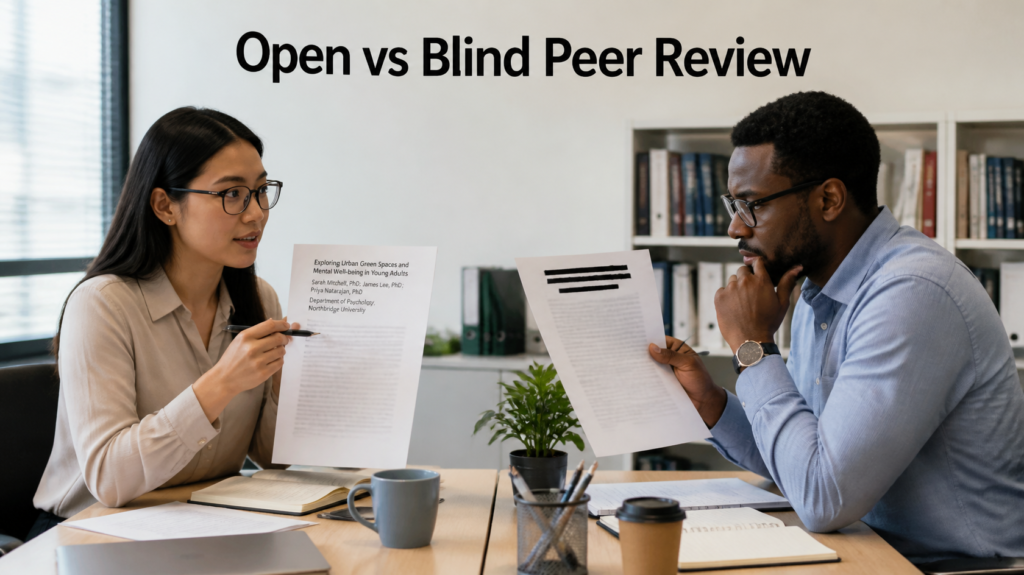
A key difference between peer review models is who knows whose identity and what is made public.
Types of Peer Review
| Model | Reviewer Knows Author? | Author Knows Reviewer? | Reviews Published? |
|---|---|---|---|
| Single-blind | Yes | No | Usually no |
| Double-blind | No | No | Usually no |
| Open identities | Yes | Yes | Sometimes |
| Transparent or open reports | Varies | Varies | Yes |
Blind Peer Review Explained
Single-Blind Review
In single-blind review, reviewers know who the authors are, but authors do not know who reviewed their work. This has long been the most common model in many sciences.
Double-Blind Review
In double-blind review, neither authors nor reviewers know each other’s identities. Authors remove identifying details from manuscripts before submission. This model is common in the humanities, social sciences, and some medical and engineering journals.
Triple-Blind Review
A less common model where even the handling editor does not know the authors’ identities during the initial assessment.
Advantages of Blind Peer Review
- Honest feedback: anonymous reviewers may feel freer to criticise work, even from senior or famous researchers
- Protection for junior reviewers: early-career researchers can review without fear of retaliation
- Reduced bias (double-blind): hiding author identities may reduce bias based on reputation, gender, nationality, or institution
- Familiar and established: widely understood by authors, reviewers, and editors
Disadvantages of Blind Peer Review
- Lack of accountability: anonymity can allow overly harsh, careless, or unprofessional comments
- Hidden conflicts of interest: authors cannot see whether a reviewer is a competitor
- Imperfect anonymity: in small fields, reviewers can often guess authors from the topic, methods, or citations
- Invisible work: reviewers receive little public credit for their contributions
- Less transparency: readers cannot see how a paper was evaluated
Open Peer Review Explained
“Open peer review” is an umbrella term that can include several practices:
- Open identities: authors and reviewers know each other’s names
- Open reports: review comments are published alongside the article
- Open participation: the wider community can comment on manuscripts, often on preprints
- Open interaction: direct discussion between authors and reviewers
Some journals publish reviewer reports with signed names, while others publish reports anonymously, an approach often called transparent peer review. Several major journals and publishers now offer transparent review options, either for all papers or on an opt-in basis.
Advantages of Open Peer Review
- Accountability: named reviewers may write more constructive, careful, and respectful reviews
- Transparency: readers can see the discussion behind the published paper
- Credit for reviewers: reviews become visible, citable contributions
- Education: published reviews help students and early-career researchers learn how to review
- Easier detection of conflicts: named reviewers make competing interests more visible
Disadvantages of Open Peer Review
- Reluctance to criticise: reviewers may soften criticism of powerful researchers
- Fear of retaliation: especially for early-career or vulnerable reviewers
- Fewer willing reviewers: some experts decline invitations when their names will be revealed
- Potential bias: author identities remain visible, so reputation effects may persist
- Extra workload: reviewers may spend more time polishing reports intended for publication
What Does Research Say?
Studies comparing peer review models have produced mixed results. Some general findings include:
- Revealing reviewer identities does not consistently change review quality, though some studies suggest reviews may become more courteous
- Open identity models can lead to more reviewers declining invitations
- Double-blind review may reduce some biases, but anonymity is often imperfect because reviewers can guess who wrote a paper
- Many researchers support publishing review reports even when they prefer anonymous reviewers
Overall, evidence suggests no single model is perfect. Each involves trade-offs between honesty, fairness, accountability, and transparency. Results can also differ between fields, journals, and research cultures, which is why many publishers continue to test new approaches.
Open vs Blind Peer Review: Key Comparisons
- Bias: double-blind aims to reduce bias against authors; open review aims to reduce reviewer misconduct
- Honesty: anonymity may encourage frankness; openness may encourage politeness and care
- Accountability: stronger in open review
- Credit: open review makes reviewer work visible
- Participation: blind review may attract more willing reviewers
Which Model Do Different Fields Use?
- Life and physical sciences: single-blind review has traditionally been common, with growing use of transparent review options
- Humanities and social sciences: double-blind review is widely used
- Medicine: practices vary, with some journals using open or signed reviews and others relying on anonymity
- Computer science conferences: often use double-blind review for submitted papers
- Preprint communities: increasingly experiment with public, open commentary
Because norms vary so much, researchers moving between fields should always check each journal’s specific policy.
The Role of Editors
Whatever model is used, editors play a central role in ensuring fairness. They select appropriate reviewers, check for conflicts of interest, moderate unprofessional comments, and make final decisions. Good editors can reduce many weaknesses of both open and blind systems by choosing balanced reviewers, providing clear guidelines, and stepping in when reviews are unhelpful or inappropriate.
Editors also decide how much weight to give conflicting reviewer opinions, which makes their own judgement and transparency important in every peer review model.
Hybrid Approaches
Many journals now combine elements of both models, for example:
- Double-blind review during evaluation, with reports published after acceptance
- Anonymous reviews with an option for reviewers to sign their names
- Publishing editorial decision letters and author responses
- Community comments on preprints alongside formal review
Tips for Authors
- Check the journal’s peer review model before submitting
- For double-blind journals, remove names, affiliations, and identifying self-citations
- Respond to reviews professionally, knowing responses may be published
- Consider whether you are comfortable with published review reports
Tips for Reviewers
- Write every review as if it might be made public
- Be constructive, specific, and respectful
- Declare conflicts of interest
- Focus on the science, not the authors
- Keep manuscripts confidential unless the journal’s policy states otherwise
Final Thoughts
The debate over open vs blind peer review reflects different values in research: protecting reviewers and reducing bias on one side, and promoting transparency and accountability on the other. Blind review offers anonymity and potentially fairer judgement, while open review brings visibility, credit, and responsibility. As journals experiment with hybrid models, the goal remains the same: fair, rigorous, and trustworthy evaluation of research.