Behind some of the largest waves of retractions in scientific publishing lies a hidden industry: paper mills. These organisations produce fake or low-quality research papers and sell authorship to people who need publications. Their activities have infiltrated journals across many fields, damaging trust in research and forcing publishers to retract thousands of articles.
This article explains what paper mills are, how they operate, why they exist, the warning signs of mill-produced papers, the damage they cause, and how the research community is fighting back.
Table of Contents
What Are Paper Mills?
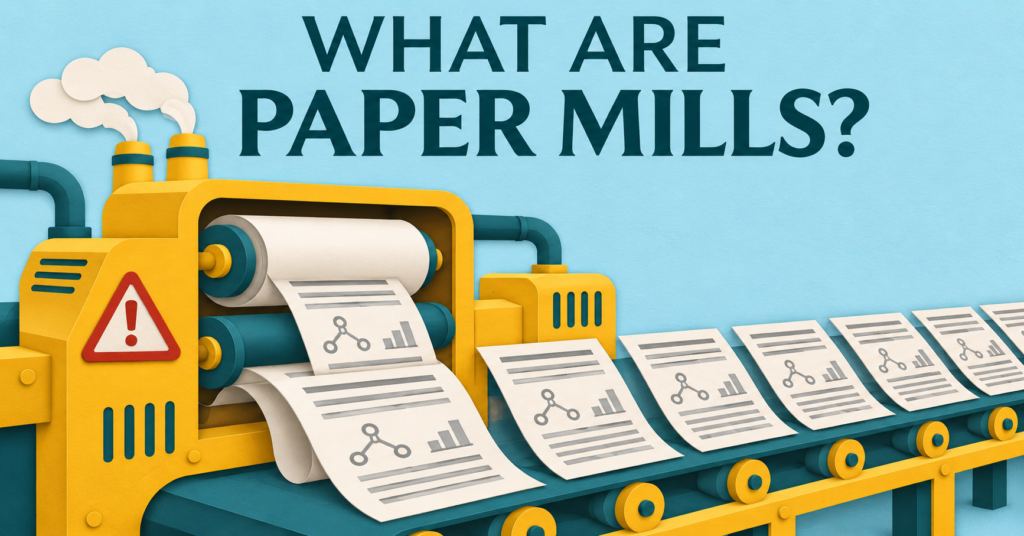
Paper mills are commercial operations that create and sell research manuscripts, authorship positions, or guaranteed publication to paying customers. The papers they produce may contain fabricated data, manipulated images, plagiarised text, or recycled templates. Customers often have little or no involvement in the research.
How Paper Mills Operate
| Service | What It Involves |
|---|---|
| Ready-made papers | Selling complete manuscripts with fabricated results |
| Authorship for sale | Offering paid author slots on papers, with prices often depending on position |
| Guaranteed publication | Promising acceptance in specific journals |
| Peer review manipulation | Using fake reviewers or compromised editors |
| Citation boosting | Adding citations to inflate metrics |
Templates and Mass Production
Many paper mills use templates, producing large numbers of similar papers with small changes in titles, genes, diseases, or materials. This allows them to generate content quickly and sell it widely.
Infiltrating Journals
Some mills target journals with weaker oversight, special issues managed by guest editors, or editors who can be bribed or deceived. Reports have described mills creating fake reviewer identities or suggesting reviewers who are actually linked to the mill.
Why Paper Mills Exist
Paper mills thrive because of strong demand for publications. Key drivers include:
- Promotion and hiring systems that heavily reward publication counts
- Requirements for publications to graduate, become doctors, or gain medical promotions in some systems
- Financial bonuses linked to publishing in certain journals
- Intense competition for research funding
- Limited time or training for genuine research among busy professionals
Reports suggest paper mills expanded significantly around the early 2010s as publication pressures grew in many countries.
Warning Signs of Paper Mill Papers
Editors and research integrity experts look for patterns such as:
- Template-like structure: papers that closely resemble others in format and wording
- Tortured phrases: odd substitutes for standard terms, such as “counterfeit consciousness” for “artificial intelligence”
- Reused or manipulated images: identical figures across unrelated papers
- Unrealistic data: results that are too neat or implausible
- Irrelevant citations: references unrelated to the topic, possibly added to boost citations
- Suspicious author details: non-institutional email addresses or authors from unrelated fields
- Unusual submission patterns: many similar papers submitted at once
No single sign proves a paper is from a mill, but combinations raise concern.
The Damage Paper Mills Cause
Polluting the Scientific Record
Fake papers can be cited, included in reviews, and used as a basis for new research, spreading false information.
Mass Retractions
Paper mills have been linked to some of the largest retraction events in publishing history. One publisher’s journals saw more than 11,000 retractions across 2023 and 2024 after mill content infiltrated special issues, and several journals were closed. Analysis reported in 2026 suggested paper mills accounted for roughly one in five health and life science retractions between 2016 and 2025.
Wasting Resources
Researchers may waste time and money trying to build on fake findings, and publishers spend significant resources investigating and retracting papers.
Harming Honest Researchers
Genuine researchers may find their fields cluttered with unreliable work, and honest authors in affected journals may suffer reputational harm.
Undermining Trust
High-profile scandals can reduce public confidence in science.
How the Research Community Is Fighting Back
- United2Act: an initiative launched in 2023 that brings together publishers, publication ethics organisations, and others to coordinate action against paper mills
- Detection tools: software that screens for tortured phrases, image duplication, and template text
- Problematic Paper Screener: an open tool that scans the literature for suspicious phrases
- Stronger peer review checks: verifying reviewer identities and limiting author-suggested reviewers
- Closer oversight of special issues: tighter control of guest editors
- Research integrity sleuths: independent experts who identify and report suspicious papers
- Policy reforms: some governments and institutions are reducing reliance on publication counts
Which Fields Are Most Affected?
Paper mills have been linked to problems across many disciplines, but reports have highlighted particular concerns in:
- Biomedical and cancer research, especially studies of genes and molecular pathways
- Clinical medicine
- Materials science and engineering
- Computer science and artificial intelligence
- Environmental and agricultural sciences
Fields with high publication volumes and formulaic study designs can be easier for mills to imitate.
Generative AI and the Future of Paper Mills
Integrity experts worry that generative AI could make paper mills even more productive. AI can write fluent text, create convincing images, and produce varied versions of the same template, making fake papers harder to detect. At the same time, AI-based screening tools are being developed to identify suspicious patterns at scale, creating an ongoing contest between fraudsters and detectors.
The Role of Institutions and Governments
Because paper mills feed on demand, lasting solutions require changes beyond journals. Universities and governments can reduce pressure by valuing research quality over publication counts, removing cash rewards for publications, investigating staff who buy authorship, and educating researchers about the risks. Some countries have already introduced reforms aimed at discouraging excessive reliance on metrics.
How Researchers Can Protect Themselves
- Never pay for authorship or guaranteed publication
- Be wary of unsolicited offers to join papers or special issues
- Check journals carefully before submitting
- Verify papers you cite, especially those with suspicious features
- Report concerns to journal editors or integrity offices
Why Buying Authorship Is Risky
Some researchers are tempted to buy authorship as a shortcut. Beyond being unethical, it carries major risks. Mill papers are increasingly detected and retracted, and authors named on them may face investigations, loss of degrees or jobs, and lasting damage to their reputations. Publishers and institutions now share information more actively, making it harder for those involved to escape consequences.
Signs of a Paper Mill Offer
- Unsolicited emails offering authorship on ready-made papers
- Price lists for author positions
- Promises of acceptance in named journals within weeks
- Requests to pay through unofficial channels
- No requirement to contribute to the research
Any of these signs should be treated as a serious warning.
Reporting Suspected Paper Mill Activity
If you notice papers with template-like structures, odd phrases, or duplicated images, you can report them to the journal editor or publisher. Post-publication review platforms also allow researchers to share concerns publicly and professionally.
Final Thoughts
Paper mills are a serious threat to research integrity, producing fake papers and selling authorship on an industrial scale. Driven by intense publication pressure, they have infiltrated journals and triggered mass retractions. Through better detection tools, international cooperation, careful editorial oversight, and reforms to research incentives, the research community is working to stop paper mills and protect the trustworthiness of science.