Science depends on trust. Researchers, doctors, policymakers, and the public rely on published results being honest and accurate. When someone inside the research community discovers fraud, data manipulation, or serious ethical violations, speaking up can protect patients, save resources, and restore confidence in science. This act of raising concerns is known as whistleblowing.
This article on whistleblowing in science explains what it is, why it matters, famous examples, the risks whistleblowers face, how reporting systems work, and how institutions can support people who speak up.
Table of Contents
What Is Whistleblowing in Science?
Whistleblowing in science happens when a person reports suspected misconduct or serious wrongdoing in research. The whistleblower is often a student, colleague, technician, peer reviewer, or journal reader who notices something wrong.
Concerns commonly involve:
- Fabrication: inventing data or results
- Falsification: manipulating experiments, images, or data
- Plagiarism: presenting others’ work as one’s own
- Ethical violations: harming research participants or skipping ethics approval
- Undisclosed conflicts of interest: hidden financial ties that bias results
- Safety risks: unsafe laboratory or clinical practices
Why Whistleblowing Matters
- Protects people: flawed medical research can lead to harmful treatments
- Corrects the record: retracting false studies prevents others from building on them
- Saves money: stops funding being wasted on unreliable work
- Maintains trust: shows that science can identify and correct its own errors
- Supports honest researchers: who are disadvantaged when others cheat
Famous Examples
Several well-known cases show how whistleblowers have exposed problems in science and medicine.
Jan Hendrik Schön
In the early 2000s, physicist Jan Hendrik Schön published a series of remarkable results in leading journals. Researchers outside his lab noticed that graphs in different papers appeared to contain identical data. Their concerns led to an investigation in 2002 that found scientific misconduct, and many of his papers were retracted.
Diederik Stapel
In 2011, junior researchers raised concerns about the work of Dutch social psychologist Diederik Stapel. Investigations found that he had fabricated data in many studies, leading to dozens of retractions. The case highlighted the courage required for early-career researchers to report a senior colleague.
Theranos
Although a company rather than an academic lab, Theranos became a landmark case. Former employees raised concerns that the company’s blood-testing technology did not work as claimed. Their reports to journalists and regulators helped reveal serious problems, leading to the company’s collapse and criminal convictions of its leaders.
Image Sleuths and Online Platforms
Today, independent researchers and data detectives examine published papers for duplicated images or impossible statistics. Platforms such as PubPeer allow readers to comment on published research, and websites like Retraction Watch track retractions and misconduct cases.
Risks Whistleblowers Face
Speaking up can be difficult and costly. Whistleblowers have reported:
- Retaliation, such as losing jobs, funding, or positions
- Damage to careers, especially for students and early-career researchers
- Strained relationships with supervisors and colleagues
- Stress, anxiety, and isolation during long investigations
- Legal threats or disputes
- Being labelled as disloyal or troublemakers
These risks can discourage people from reporting, which is why protections and fair processes are so important. Surveys of researchers in many countries suggest that a significant number have witnessed questionable practices but chose not to report them, often out of fear for their careers.
How Reporting Systems Work
| Reporting Channel | What It Handles |
|---|---|
| Institutional research integrity officer | Allegations of misconduct within a university or institute |
| Ethics committee or IRB | Concerns about participant safety and ethics approvals |
| Journal editors | Problems with published or submitted papers |
| Funding agencies | Misuse of grants or misconduct in funded research |
| National integrity bodies | Oversight of investigations, such as the U.S. Office of Research Integrity for certain federally funded research |
Typical Investigation Process
- Allegation: a concern is reported, ideally in writing with evidence
- Assessment: officials decide whether the allegation falls under misconduct policies
- Inquiry: a preliminary review determines whether a full investigation is needed
- Investigation: a detailed examination of records, data, and interviews
- Findings and actions: outcomes may include corrections, retractions, sanctions, or clearing the accused
Fair processes protect both whistleblowers and the people accused, who deserve due process and confidentiality until findings are made.
Protections for Whistleblowers
Many institutions and governments have policies designed to protect people who report concerns in good faith. These may include:
- Confidentiality for the person making the report, as far as possible
- Rules against retaliation
- Options for anonymous reporting
- Support from ombudspersons or integrity offices
- Legal whistleblower protections in some countries and sectors
The level of protection varies widely between countries and institutions, so it is important to understand local rules before reporting.
How to Raise a Concern Responsibly
- Gather facts: document specific evidence rather than relying on rumours
- Keep records: save copies of data, emails, and notes in a secure place
- Seek confidential advice: talk to an ombudsperson, integrity officer, or trusted mentor
- Use official channels: follow your institution’s reporting procedures
- Stay objective: focus on the evidence, not personal conflicts
- Consider legal advice: especially in serious or high-risk situations
- Look after yourself: seek emotional support during the process
The Role of Journals and Retractions
Journals are often where problems first become visible. When readers or whistleblowers raise concerns about a published paper, editors may:
- Ask the authors to explain or provide original data
- Contact the authors’ institution to request an investigation
- Publish an expression of concern while questions are examined
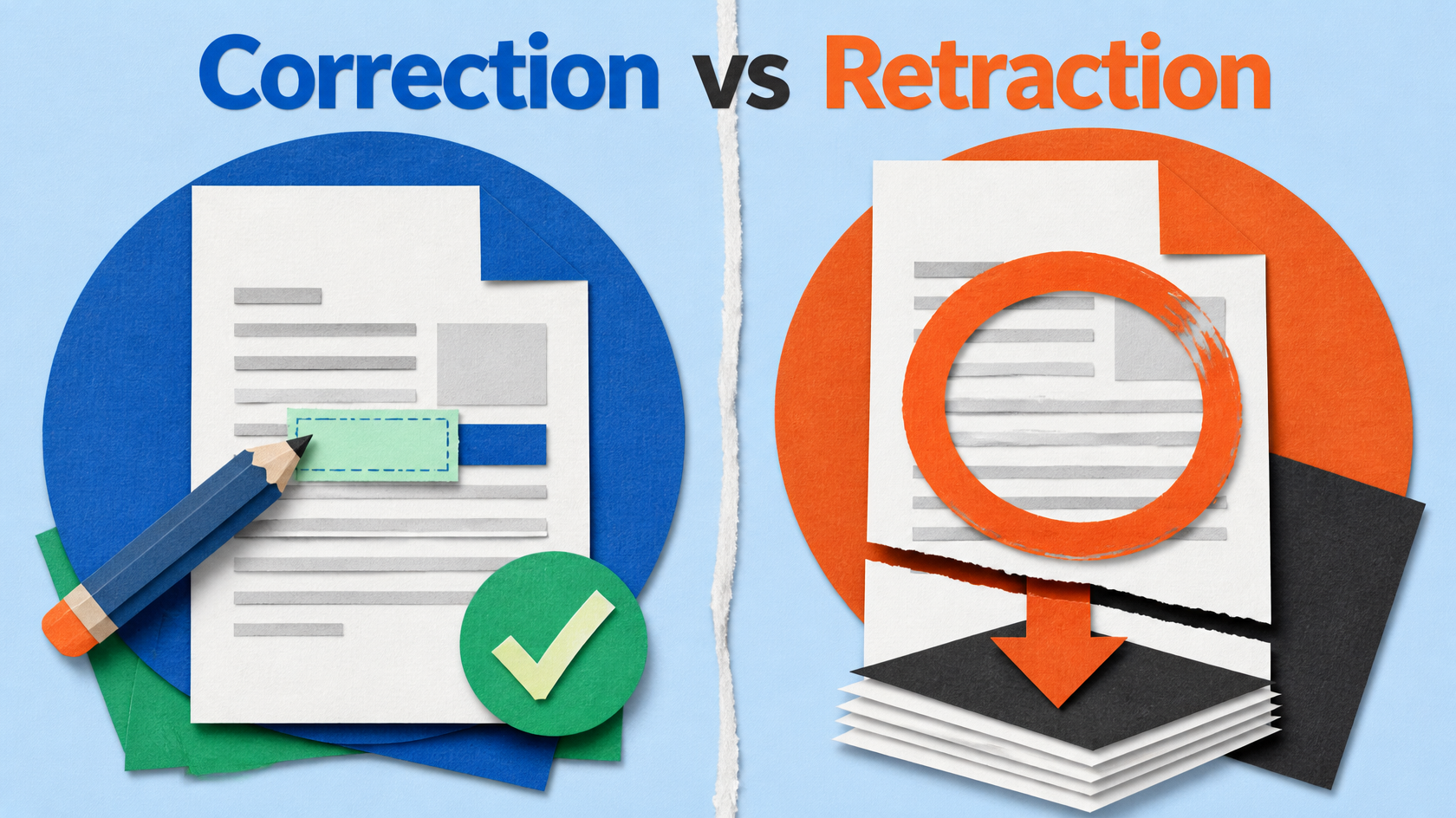
- Issue a correction for honest errors
- Retract the paper if results are unreliable or misconduct is confirmed
Many journals follow guidance from the Committee on Publication Ethics on handling such cases. Clear retraction notices help other researchers know which findings should no longer be trusted.
How Open Science Helps
Open science practices make problems easier to detect and harder to hide. Sharing raw data, code, and detailed methods allows other researchers to check and reproduce results. Pre-registering studies reduces the temptation to change hypotheses after seeing the data. When research is transparent from the start, fewer issues require whistleblowing later, and those that do arise can be resolved more quickly.
Honest Mistakes vs Misconduct
Not every error is misconduct. Science involves uncertainty, and honest mistakes, differences in interpretation, or disagreements about methods are not fraud. Responsible whistleblowing focuses on serious, evidence-based concerns, while researchers who discover their own errors should correct them openly.
How Institutions Can Build a Speak-Up Culture
- Train students and staff in research integrity and reporting options
- Make reporting procedures clear and easy to find
- Respond quickly and fairly to concerns
- Protect whistleblowers from retaliation
- Reward transparency, data sharing, and error correction
- Encourage leaders to model openness
Final Thoughts
Whistleblowing in science plays a vital role in keeping research honest and safe. From exposed fraud in physics and psychology to medical technology scandals, people who speak up have helped correct the scientific record and protect the public. With fair processes, strong protections, and a culture that values integrity, institutions can make it easier and safer for anyone to raise concerns.
This article is for general information only and is not legal advice.